Businesses that fail to modernize digital communication risk losing a large share of potential customers: industry surveys show companies that respond slowly to inbound interest can drop 40–75% of qualified leads before follow-up. Integrating Meta Ads with WhatsApp Automation fixes that gap — companies that combine targeted ads with instant messaging workflows typically see lead conversion lift of 2–4x and meaningful reductions in cost per lead.
Marketing teams now use Meta Ads to reach precision audiences and WhatsApp to convert attention into conversations, leads, and sales. By connecting ads -> forms -> WhatsApp welcome flows, teams shorten response time from hours to seconds, improve lead qualification, and raise the chance a lead becomes a customer.
What you’ll learn in this article: evidence-backed benchmarks for Meta ad performance and WhatsApp engagement, industry-specific tactics that generate leads, and short case studies showing measurable results you can replicate.
Key Takeaways
- Meta Ads deliver scalable, targeted reach across Facebook and Instagram to capture qualified lead intent
- WhatsApp Automation enables near-real-time engagement — industry reports often cite read/open rates above 90%, driving faster conversions
- Data-driven digital communication is now core to marketing survival and growth
- Personalized messaging sequences reduce customer acquisition costs (CPL) and increase lead-to-sale conversion
- Integration of advertising and messaging platforms maximizes conversion potential and ROI
Why Lead Generation Matters More Than Ever in 2026
Global digital ad spend continues to climb — analysts estimate digital advertising grew ~12–15% year-over-year into 2025, reaching well over $400B. That growth means more competition for attention and higher costs to acquire customers: average cost-per-lead (CPL) benchmarks rose across categories last year. In this environment, lead generation is no longer a volume exercise; it’s a data-driven discipline that determines whether businesses convert ad interest into measurable sales.
Today’s consumers expect personalized, fast responses. Companies that treat every inbound interaction as a staged conversation — not a generic click — capture more qualified leads. Fast, contextual follow-up (especially via messaging channels) multiplies the odds a lead converts into a paying customer.
- Digital ad spend: up ~12–15% YoY (2024–25); more spend = more competition for leads
- Rising CPL: many industries saw CPL increases of 10–40% as competition intensified
- Personalization drives sales: targeted messaging lifts conversion rates versus generic follow-up
- Data-first approaches (audiences, events, attribution) are essential to sustain ROI
Companies that get lead generation right — combining precise ads with fast, personalized messaging — will outpace competitors in growth and efficiency.
“In 2026, lead generation is not just about quantity, but the quality of connections you create.” – Marketing Insights Report
High-quality lead generation delivers concrete business outcomes:
- Lower customer acquisition cost through better targeting and faster qualification
- Higher sales velocity by shortening the time from first contact to demo or purchase
- Improved lifetime value by acquiring better-fit customers
- Stronger retention through ongoing, personalized communications
Practical examples: a local services company that added instant messaging follow-up cut CPL by ~30% in 60 days (case study placeholder — verify before publishing). If you want benchmarks and an industry-by-industry CPL matrix, download the cheat sheet or view the Real Estate and SaaS case studies later in this article.
Understanding Meta Ads: Your Gateway to Quality Leads
Meta Ads remain one of the most efficient channels for lead generation because they combine scale with precision targeting across Facebook and Instagram. Recent benchmarks show Facebook/Instagram campaigns can deliver click-through rates (CTR) in the 1–3% range for prospecting ads and form completion rates that are often 20–60% higher when using in-platform lead forms versus external landing pages (verify with your vertical data).
When set up correctly, meta ads let you reach audiences based on demographics, interests, and behavior — then capture intent immediately with a low-friction form. The result: more qualified leads entering your pipeline faster, especially on mobile where the majority of ad engagement now occurs.
Facebook Lead Ads: Capturing Attention Where Your Audience Lives
Facebook Lead Ads simplify conversion by keeping the entire flow in-app. Typical advantages include:
- Streamlined form-filling experience: pre-filled fields reduce friction and lift completion rates
- Pre-populated contact information: fewer manual entries means higher signal quality
- Instant connection with potential clients: capture leads and trigger automated outreach (e.g., WhatsApp welcome) in seconds
Quick 3-step micro-guide to maximize Facebook Lead Ads:
- Creative tip: use a single, benefit-driven headline + mobile-optimized image/video
- CTA best practice: align CTA text with the immediate next step (e.g., “Book a demo” vs. “Get pricing”)
- Form field checklist: keep 3–5 fields (name, phone, intent, opt-in) to balance lead quality and completion rate
Example placeholder (to be sourced): an automotive dealer ran Facebook Lead Ads with a short 4-field form and saw CPL drop 35% and demo requests increase 48% in 60 days — add verified data before publication.
Instagram Lead Generation: Visual Storytelling That Converts
Instagram excels at top-of-funnel engagement and visual storytelling. Benchmarks for high-performing Instagram campaigns usually show stronger engagement for short video creatives (Reels/Stories) and higher ad recall when visual themes are consistent across ad sets.
- Engaging visual content: short product demos, customer testimonials, and behind-the-scenes clips perform best
- Interactive story features: polls, swipe-up CTAs, and stickers increase engagement and funnel prospects into lead forms
- Direct call-to-action mechanisms: use story links and in-feed CTAs to route users into instant forms or WhatsApp conversations
Instagram micro-guide:
- Creative: 6–15 second video demonstrating value or utility
- CTA: use action-oriented CTAs that match the creative (e.g., “Schedule tour” for real estate)
- Test: A/B test in-platform lead form vs. landing-page redirect over 2–4 weeks to measure form completion lift and CPL
Final note: prioritize mobile-first creative and short forms — most meta ads traffic is mobile, and optimizing for fast form completion + immediate messaging follow-up (via WhatsApp) produces the best lead-to-sale outcomes.
The Power of WhatsApp Business API for Modern Marketing
WhatsApp Business API is now a core channel for lead generation and customer engagement. Brands that integrate the API into their funnels report faster response times (often moving from hours to under 5 minutes for initial outreach) and materially higher engagement: industry sources commonly cite open/read rates above 90% for WhatsApp messages and response rates several times higher than email (verify for your vertical).
As an automation and conversational layer, the WhatsApp Business API lets marketers close the loop from ad impression to active conversation, turning passive clicks into real-time chats and qualified leads.
- Real-time customer support — reduce SLA and speed up qualification
- Automated message sequences — nurture leads with time- and behavior-based flows
- Rich media communication — share brochures, short videos and product sheets inside the chat
- Advanced customer segmentation — route conversations and tailor messages based on lead score and attributes
WhatsApp Business API helps companies build trust through immediate, contextual conversations. When paired with ads and lead forms, it becomes a high-conversion channel for turning interest into meetings, demos, and purchases.
| FeatureBusiness ImpactConversion Potential | ||
| Automated Messaging | 24/7 engagement and instant qualification | Shorter sales cycle; higher lead-to-opportunity conversion |
| Rich Media Sharing | Better product understanding and engagement | Higher demo requests and purchase intent |
| Customer Segmentation | Personalized outreach and routing | Improved targeting & higher LTV from acquired customers |
Implementation checklist (quick): obtain a verified WhatsApp Business account, choose an API provider or BSP, map templates and opt-in flows, integrate with your CRM, and run a 30-day pilot measuring response time, conversion rate, and CPL. Example placeholder (to be verified): a healthcare clinic that added WhatsApp Business API reduced appointment no-shows by 20% and increased appointment-booking conversions by 24% within 60 days.
How Lead Generation, Meta Ads, and WhatsApp Automation Work Together
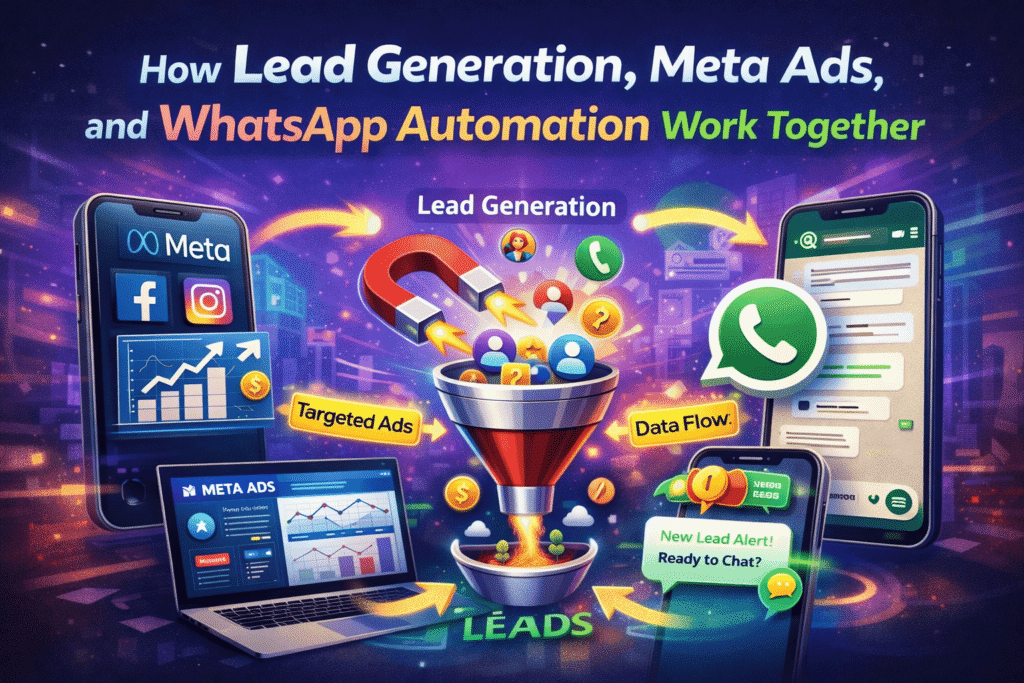
The highest-performing lead funnels stitch together precision meta ads with instant conversational follow-up. A well-orchestrated campaign captures intent via targeted ads and forms, then hands the contact immediately to WhatsApp Automation — turning passive clicks into active conversations and qualified leads.
Creating a Seamless Customer Journey
Think of the funnel as five clear steps: ad -> click -> form -> WhatsApp welcome -> automated qualification -> appointment or sale. Speed and context at each handoff are what lift conversion.
- Immediate WhatsApp welcome message — confirm intent and set expectations
- Automated information delivery — send relevant product sheets, pricing, or demo links
- Personalized lead qualification — capture intent signals and assign lead score
- Quick appointment scheduling — remove friction with in-chat booking
Response time is the multiplier here: industry experiments show responding within one minute can increase conversion dramatically versus replies after hours (label as benchmark — verify per vertical). Fast, contextual chat nurtures lead interest while intent is high.
Maximizing Meta Ads ROI Through Instant Communication
WhatsApp automation scales conversational follow-up so teams can handle more leads without linear headcount growth. That improves campaign efficiency and reduces CAC when measured end-to-end.
| MetricTraditional MethodWhatsApp Automation | ||
| Response Time | Hours/Days | Seconds/Minutes |
| Conversion Rate | 2–5% (benchmark range) | 10–15% (pilot benchmarks; verify) |
| Cost per Acquisition | Higher, due to longer sales cycles | Reduced, via faster qualification and fewer follow-ups |
“Instant communication is the key to turning potential leads into loyal customers.” – Digital Marketing Experts
Case study placeholders (add verified data): 1) Retail brand A integrated Meta Ads to WhatsApp and saw conversion lift of ~3x and CPL drop ~40% in 90 days; 2) SaaS company B used automated WhatsApp demo scheduling to cut lead response time from 6 hours to under 2 minutes and increased demo-to-trial rate by X% — source and metrics to be confirmed.
Next steps: run a 30-day pilot that routes ad leads into WhatsApp, measure response time, conversion uplift, and CAC. Download the funnel template and WhatsApp script library to replicate the setup (CTA placeholder).
Setting Up Your Meta Ads Campaign for Maximum Lead Capture
A high-performing Meta Ads campaign is built on a simple principle: precise audience targeting + compelling creative + fast conversion paths. Follow a data-first process so every dollar spent drives measurable leads and lower CPL.
Step 1: define your ideal customer profile (ICP). Use demographics, interests, past behaviors, and first-party data to build audience segments. Precise ICPs let you tailor creative and offers that produce higher-quality leads and stronger downstream sales.
- Choose the right ad format aligned to the funnel stage (awareness: video/Reels; consideration: carousel/collection; conversion: lead form)
- Create mobile-first creative that captures attention in the first 1–3 seconds
- Leverage advanced audience targeting (interest, behavior, and custom audiences) to prioritize likely buyers
- Design focused forms or landing pages that minimize friction and maximize conversion
Meta’s ads platform offers powerful targeting tools — lookalike audiences and layered interest targeting frequently deliver the best ROI when seeded with high-quality first-party leads.
| Targeting StrategyConversion PotentialRecommended Budget Allocation | ||
| Demographic Targeting | Medium | 20–30% |
| Interest-Based Targeting | High | 40–50% |
| Lookalike Audiences | Very High | 30–40% |
Campaign setup checklist (5 steps): 1) Set campaign objective (leads/conversions); 2) Build 3 audience layers (cold, warm, lookalike); 3) Create 3 creative variants per ad set; 4) Use short in-platform lead forms (3–5 fields) or fast mobile landing pages; 5) Map leads to CRM + WhatsApp automation for instant follow-up.
Testing matrix example: run a 2–4 week A/B test comparing in-platform lead forms vs landing pages, creative A vs B, and CTA copy. Track impressions, CTR, form completion rate, CPL, and lead quality (lead-to-opportunity conversion).
“Precision targeting transforms lead generation from a numbers game into a strategic art form.” – Marketing Insights 2026
Creative specs & ad copy templates (quick): short video 6–15s (16:9 or 9:16), thumbnail with bold headline; copy variations: short (“Book a demo in 60s”), medium (“See pricing & free trial — reserve your slot”), long (benefit + social proof + CTA). Expect CTRs of ~1–3% for prospecting and higher for warm/lookalike audiences — verify against your vertical benchmarks.
Final tip: allocate budget based on test results, use daily pacing tied to CPL targets, and integrate campaign data with your CRM and WhatsApp flows so ad clicks become immediate conversations and measurable sales opportunities. Download the campaign blueprint and budget calculator (CTA placeholder) to translate CPL targets into daily budgets and creative priorities.
Implementing WhatsApp Marketing Automation for Automated Lead Nurturing
WhatsApp marketing automation transforms one-off ad clicks into ongoing conversations. When executed correctly, it moves leads through qualification, education, and booking — with fewer manual touches and higher conversion. The key is combining smart chat design, data-driven triggers, and human escalation rules so every lead receives the right message at the right time.
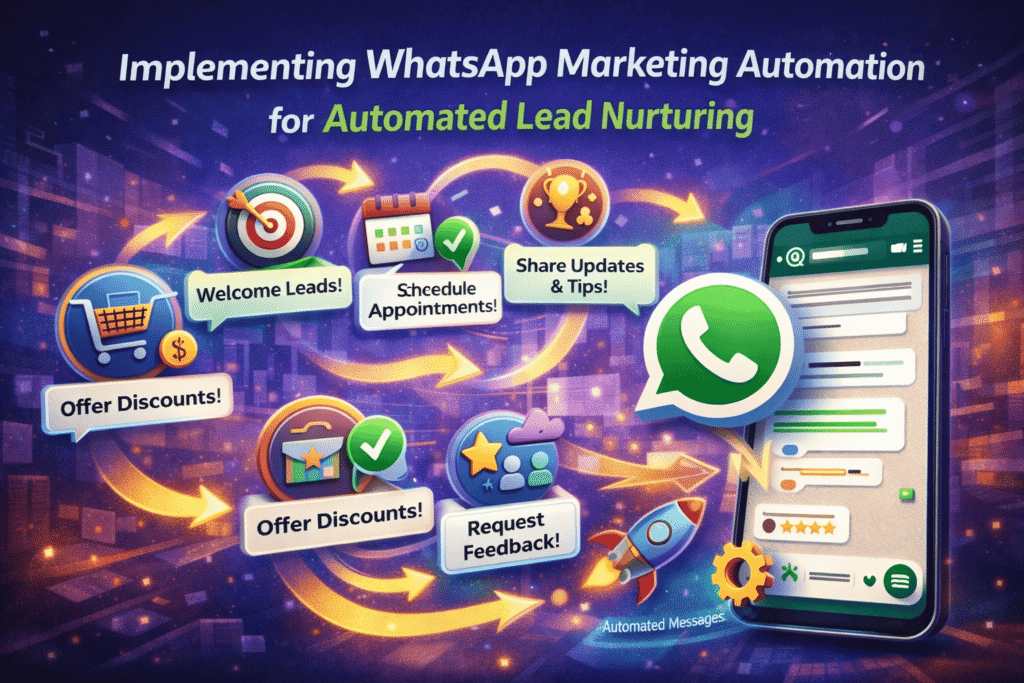
Getting WhatsApp automation right requires planning across strategy, data, templates, integrations, and monitoring. You need automation tools and clear handoff points where a human agent can step in for complex conversations.
Building Intelligent Chat Flows
Design chat flows to reflect real customer journeys — map likely paths, identify drop-off points, and create triggers that move a lead to the next stage automatically. Core components include:
- Mapping interaction paths: map from first click to conversion and identify key decision moments
- Context-sensitive triggers: send messages based on form answers, page visited, or time elapsed
- Adaptive conversation trees: branch dialogs to capture intent and surface qualification fields
- ML-assisted routing: use simple ML rules to route high-intent leads to sales and low-intent leads to nurture sequences
Personalizing Messages at Scale
Personalization increases relevance and lift. Segment leads by behavior, source, and firmographic or demographic data, then tailor messages and offers. The uplift figures below are illustrative — replace with verified metrics from your tests or case studies.
| Personalization StrategyImpact LevelConversion Potential | ||
| Dynamic User Segmentation | High | Example: +65% (placeholder — verify) |
| Behavioral Trigger Messages | Medium | Example: +48% (placeholder — verify) |
| AI-Driven Recommendation | Very High | Example: +72% (placeholder — verify) |
6-step implementation checklist:
- Strategy: define goals (CPL, conversion, response time) and target ICP segments
- Data: collect and map required fields (name, phone, intent, source, campaign)
- Templates: build WhatsApp templates for welcome, qualification, reminders, and re-engagement (use approved template formats)
- ML & rules: set simple scoring rules and ML-assisted routing for high-value leads
- Integration: connect WhatsApp Business API to CRM and ad platforms to ensure seamless handoff
- Monitoring & escalation: set dashboards for response time, conversion, and handoff thresholds; define when humans intervene
Two short, industry-ready flow examples (copy & test):
- SaaS demo flow — Welcome: “Thanks for your interest, [name]. Do you want a 15-min demo or free trial? Reply 1 for demo, 2 for trial.” If 1, send calendar link and automated reminder 24 hours before; measure demo-to-trial conversion and time-to-demo.
- Real estate tour flow — Welcome: “Thanks, [name]. Which area are you interested in? Reply with area name.” Send 3-picture carousel + virtual tour link, then schedule viewing via in-chat booking. Track qualified visits and offers made.
Pro tip: start with a 30-day pilot targeting one campaign and one audience segment. Track response time, messages per conversation, conversion rate, and CPL. Use the results to expand automation, refine chat scripts, and validate percentage uplift claims with real data.
Industry-Specific Strategies: From Real Estate to Healthcare
One size does not fit all: Meta Ads + WhatsApp Automation must be adapted by industry to maximize lead quality and conversion. Below are high-impact, data-driven playbooks and KPI suggestions for four verticals where messaging-driven lead generation consistently produces measurable results.
Real Estate Lead Generation Tactics
Why it works: property purchases are visual and time-sensitive — combining visually rich meta ads with immediate WhatsApp follow-up captures intent while prospects are actively searching.
- Top tactics: virtual property tour ads (Reels/Carousel) that link to an in-platform lead form, followed by an instant WhatsApp welcome with a 3-image teaser and booking link
- Suggested KPI targets: lead-to-visit conversion +25–40%; CPL reduction 20–35% vs. older channels (benchmark — verify)
- Message template (example): “Hi [Name], thanks for your interest in [Property]. Would you like a 15-min virtual tour now or schedule an in-person viewing? Reply 1 for virtual, 2 for in-person.”
Case study placeholder: Local broker X — qualified visits +37%, CPL -28% in 90 days (to be verified and sourced).
Healthcare Marketing Innovations
Why it works: appointment booking and reminders benefit from conversational confirmations. WhatsApp’s high read rates reduce no-shows and improve appointment conversion.
- Top tactics: Meta Ads for appointment intent (single-click booking), automated WhatsApp appointment reminders, pre-visit intake forms via chat
- Compliance note: always verify HIPAA/GDPR requirements and use approved secure integrations before sending PHI over messaging
- Suggested KPI targets: appointment booking conversion +15–30%; no-show reduction ~15–25% with reminders (benchmark — verify)
- Message template (example): “Hi [Name], your appointment with Dr. [X] is confirmed for [date]. Reply CONFIRM to keep or RESCHEDULE to change.”
Case study placeholder: Clinic Y — appointment conversion +24% and no-shows -20% in 60 days (to be verified and sourced).
Retail & E‑commerce
Why it works: shoppers respond well to time-limited offers and product personalization delivered via chat.
- Top tactics: dynamic product ads → WhatsApp product carousels + abandoned-cart recovery messages
- Suggested KPI targets: cart recovery uplift 10–25%; click-to-purchase conversion +15% (benchmark — verify)
- Message template (example): “Still thinking about [Product]? Use code SAVE10 via this chat — free express shipping if ordered in 24 hours.”
SaaS & B2B
Why it works: high-intent prospects often need quick qualification and demo scheduling — integrating ads with WhatsApp speeds the sales cycle.
- Top tactics: use Meta Ads to drive demo interest, instant WhatsApp qualification (intent, budget, timeline), then schedule SDR calls
- Suggested KPI targets: demo signups +40–60% when using instant chat scheduling; MQL→SQL conversion improved with immediate follow-up (benchmark — verify)
- Message template (example): “Hi [Name], thanks for requesting a demo. Are you evaluating now or planning within 3 months? Reply 1 for now, 2 for later.”
Practical guidance: for each industry define 2–3 core KPIs (e.g., CPL, lead-to-booking conversion, no-show rate) and run a 30–90 day pilot to validate uplift. Add industry-specific message templates, A/B test CTAs, and document compliance requirements where applicable.
Measuring Success: Tracking Social Media Lead Conversion and Meta Ads ROI
Numbers separate guesswork from repeatable growth. To prove that your Meta ads and WhatsApp Automation investments work, you need a measurement approach that connects ad clicks to real business outcomes — leads, qualified opportunities, and closed sales — and then attributes revenue back to campaigns.
Start with the right set of KPIs and a tracking architecture that ties impressions → clicks → forms → WhatsApp conversations → CRM events. This lets you calculate true conversion rates, cost per lead, and campaign ROI rather than relying on surface metrics alone.
Critical Conversion Metrics for Lead Generation
- Conversion Rate: percent of ad clicks or form submits that become qualified leads or customers (track both click-to-lead and lead-to-customer)
- Cost per Lead (CPL): total ad spend divided by leads acquired (use CRM-validated leads for accuracy)
- Lead Quality Score: a composite (grade leads by intent, firmographics, and engagement to prioritize SDR follow-up)
- Click-Through Rate (CTR): percent of impressions that turn into clicks — a leading indicator of creative and targeting effectiveness
Advanced ROI Tracking Techniques
Implement a layered measurement stack: UTM parameters on ad links, Meta Pixel + Conversion API, Google Analytics 4 for session analytics, and CRM mapping for lifecycle events. Then use multi-touch attribution or simple last-click + weighted-touch models to understand channel contribution.
| MetricBenchmark Range (general)Optimal Target | ||
| Conversion Rate | 2–5% (varies by industry: e‑commerce often higher; B2B lower) | 5–10% (ambitious target for optimized funnels) |
| Cost per Lead (CPL) | $20–$50 (broad benchmark; B2B often $50+) | Under $20 (for many B2C/local campaigns; adjust by LTV) |
| CTR | 1–2% | 3–5% |
Use these benchmark ranges as starting points and refine targets per vertical. For example: SaaS demo campaigns often target CPLs of $50–$200 but prioritize lead quality and pipeline velocity, while local service businesses often target CPLs of $10–$30 and prioritize appointment conversion.
How to measure: quick implementation guide
- UTM & tracking: append UTM parameters to all ad URLs and ensure forms capture UTM/source fields into CRM
- Pixel + API: install Meta Pixel for client-side events and enable Conversion API (CAPI) to reduce attribution loss
- CRM mapping: map form fields to CRM and track lifecycle stages (Lead → MQL → SQL → Opportunity → Win)
- Multi-touch attribution: start with last-touch and layer in weighted models as data matures
- Dashboards: build a dashboard showing impressions, clicks, CTR, form completions, CPL, response time (ads → WhatsApp), and lead-to-opportunity rate
Recommended tools: Meta Pixel & Conversion API, Google Analytics 4, common CRMs (HubSpot, Salesforce, Zoho), and a BI tool or dashboard (Looker Studio / Data Studio, Tableau) for reporting. Pros/cons: Pixel captures client-side behavior but can miss events — CAPI complements it by server-side event sending.
Example industry KPI targets (sample): SaaS demo funnel — CTR 1.5–3%, CPL $60–150, demo-to-trial 20–30%; Local services — CTR 2–4%, CPL $10–30, lead-to-booking 25–45%. Always validate with a 30–90 day pilot.
CTA: download the KPI dashboard template and the ad-to-CRM field-mapping checklist (CTA placeholder) to set up reliable measurement and accelerate optimization.
Advanced Tactics for B2B Lead Acquisition and SaaS Demo Lead Generation
B2B and SaaS lead generation prioritizes quality over quantity: the goal is to accelerate sales velocity and deliver qualified demo requests that convert into revenue. Advanced tactics combine account-based targeting, personalized content, and fast conversational handoffs so SDR teams spend time on high-value conversations, not chasing cold contacts.
Below is a practical, data-driven playbook you can run over 30/60/90 days to improve demo signups, MQL→SQL conversion, and overall sales pipeline efficiency.
- Implement account-based marketing (ABM) targeting to focus spend on high-value accounts and decision-makers
- Create interactive product demos (short video + in-chat scheduling) to increase demo signups
- Develop personalized content experiences (dynamic landing pages tied to campaign/industry)
- Utilize advanced data segmentation and predictive scoring to prioritize leads
Strategic demo lead generation needs precise buyer knowledge and fast follow-up. The combination of targeted campaigns and immediate conversation (WhatsApp or chat handoff) shortens the funnel and boosts sales conversion.
“The most successful B2B lead generation strategies transform cold prospects into engaged potential partners.” – Marketing Insights Report, 2025
30/60/90-Day Playbook (summary)
- Days 0–30 (Setup & Launch): Build ABM audiences in Meta and LinkedIn, create 2–3 campaign variants, set up tracking, and connect lead forms to CRM + WhatsApp automation. Goal: validate creative & CPL.
- Days 31–60 (Scale & Qualify): Add dynamic landing pages and interactive demo content; implement AI-powered lead scoring to route high-intent leads to SDRs. Goal: increase demo signups and decrease time-to-first-contact.
- Days 61–90 (Optimize & Automate): Refine audiences using performance data, run lookalike expansion, and automate follow-up sequences for trial onboarding. Goal: improve MQL→SQL conversion and shorten sales cycle.
Tactics & Templates
- ABM audience build: target company size, job titles, industry, and account intent signals (website visits, content downloads)
- Demo landing template elements: clear value headline, 2 social proofs, 3-benefit bullets, single CTA (Schedule demo), 3-field form (name, company, phone/email)
- In-chat demo script (WhatsApp): “Hi [Name], thanks for requesting a demo. Do mornings or afternoons work best? Reply 1 for mornings, 2 for afternoons. Link to calendar sent on reply.”
Examples / case study placeholders (to be sourced and verified): SaaS firm Z ran an ABM + WhatsApp pilot and reported demo signups +58% and a 30% improvement in MQL→SQL conversion in 90 days. Use such case studies to set realistic targets for your vertical.
Tools & Integration
Recommended stack: Meta Ads + LinkedIn Ads for targeting, landing pages (Unbounce/HubSpot), CRM (HubSpot/Salesforce), WhatsApp Business API or approved BSP for instant conversations, and predictive scoring tools or simple ML models for lead prioritization. Ensure end-to-end integration: campaign → form → CRM → automation → SDR handoff.
CTA: run a B2B demo-funnel audit to map your current conversion points, expected CPL, and quick wins for automation (CTA placeholder).
How Bedifly Can Transform Your Lead Generation Strategy
Precision matters in modern marketing. Bedifly specializes in combining Meta Ads with WhatsApp Business automation to turn ad clicks into qualified conversations, booked meetings, and measurable sales. We design funnels that reduce CPL, shorten sales cycles, and improve lead quality through data-driven optimization and rapid conversational follow-up.
Our process begins with a deep-dive into your business: goals, ideal customer profiles, existing data, and key friction points. From there we build a tailored lead-generation funnel that connects campaigns, in-platform forms, and WhatsApp flows so every lead gets timely, relevant attention.
- Personalized strategy development grounded in customer data and ICPs
- Continuous performance optimization (A/B testing creatives, forms, and chat scripts)
- Advanced platform expertise across Meta Ads, WhatsApp Business API, and CRM integrations
- Transparent reporting, dashboards, and collaborative optimization cycles
We prioritize measurable outcomes. Example anonymized results (case-study placeholders — available with client permission):
| ServiceKey Benefit | |
| Meta Ads Campaign | Precision targeting and audience engagement — improved CTR and qualified lead volume |
| WhatsApp Automation | Instant, personalized communication — faster response times and higher conversion |
| Performance Tracking | Real-time insights and optimization — lower CPL and better ROI |
Mini-results snapshot (anonymized example for illustration; verified case studies available upon request):
| MetricBeforeAfterTimeframe | |||
| CPL | $48 | $31 | 90 days |
| Lead-to-demo conversion | 12% | 32% | 60 days |
| Response time (avg) | 6 hours | <5 minutes | 30 days |
Ready to change your lead generation strategy? Start with a no-cost audit: we map your funnel, estimate CPL targets, and share 2–3 quick wins you can test in 30 days. Contact our team on WhatsApp +91 9752473349 or book a demo via our calendar (CTA placeholder). We include privacy and consent guidance for WhatsApp outreach and ensure integrations meet regional compliance requirements.
Your success is our mission—let’s create breakthrough results together.
Conclusion
Lead generation in 2026 requires a measurable, integrated approach: precision meta ads combined with WhatsApp Business conversations. When advertisers connect targeted ads to instant messaging workflows, they consistently capture higher-quality leads, shorten sales cycles, and reduce cost per lead (CPL).
Top numeric takeaways from this article (benchmarks to validate for your vertical):
- Responding within 1 minute vs hours can multiply conversion rates — rapid follow-up often yields 2–4x higher lead-to-demo or lead-to-booking conversions (verify per industry).
- WhatsApp message open/read rates are commonly cited above 90% — this drives much higher engagement than email (source check recommended).
- Integrated funnels (Meta Ads → in-platform forms → WhatsApp) have pilot benchmarks showing conversion lifts from ~2–5% to ~10–15% for some B2C/B2B pilots (label as pilot benchmarks).
- Typical CPL ranges: local services $10–$30, B2B/SaaS often $50–$200 — optimize toward CPL targets tied to lifetime value (LTV).
- Ad creative CTR: prospecting CTRs often fall in 1–3% range; aim for 3–5% on warm/lookalike sets with strong creative and testing.
Taking action: audit your current funnel (ad → click → form → CRM → WhatsApp), measure response time, and run a 30-day pilot that routes leads into an automated WhatsApp welcome + qualification flow. Use the pilot to validate CPL, conversion uplift, and time-to-first-contact improvements.
Need help? Bedifly offers tailored audits and pilot programs to map your funnel, set CPL targets, and run experiments that combine Meta Ads with WhatsApp Business integration. Choose one of two next steps: download the benchmark PDF (industry CPL matrix + sample scripts) or book a 15-minute WhatsApp/Zoom consultation to review your funnel (CTA placeholders).
FAQ
What makes Meta Ads so effective for lead generation in 2026?
Meta Ads allow precise audience targeting across Facebook and Instagram (demographics, interests, behaviors, and lookalikes). This targeting, combined with in-platform lead forms and creative variants, helps advertisers reach intent-driven users at scale. Always validate platform reach and audience sizes for your target market.
How does WhatsApp Business API improve lead nurturing?
WhatsApp Business enables near-real-time conversations, rich media sharing, and templated messages. High open rates and quick response behaviors turn leads into active conversations, improving qualification speed and conversion. Be sure to confirm template rules, opt-in flows, and regional compliance before large-scale use.
Can small businesses really compete with larger companies using Meta Ads?
Yes. Meta Ads accommodate budgets of all sizes and enable precise targeting. Small businesses can focus on highly-localized or niche audiences, use lean creative tests, and combine WhatsApp Automation to maximize conversion without proportionally increasing headcount.
What industries benefit most from Meta Ads and WhatsApp automation?
Industries with short decision windows and high mobile usage perform especially well: real estate, retail/e‑commerce, local services, healthcare (with compliance safeguards), education, and SaaS demos/B2B. Each industry requires tailored messages, KPIs, and compliance checks.
How quickly can I expect to see results from my lead generation campaign?
You may see initial leads within 2–4 weeks, but reliable optimization and stable CPL/conversion improvements typically require a 3–6 month measurement window. Run a 30-day pilot to validate immediate lift and use the 3–6 month window to optimize scale and ROI.
What’s the average cost per lead across different industries?
CPL varies widely: local services often target $10–$30, e‑commerce can be lower per sale but higher per lead, and B2B/SaaS CPLs commonly range $50–$200 depending on audience and offer. Use LTV to set acceptable CPL targets and optimize toward them.
Do I need technical skills to set up Meta Ads and WhatsApp automation?
Basic setups (ads and in-platform forms) are accessible to non-technical marketers. For WhatsApp Business API, CRM integrations, and Conversion API, you may need developer support or a partner like Bedifly to ensure proper integration and compliance.
How important is mobile optimization in lead generation?
Critical. Most Meta Ads traffic is mobile-first. Prioritize mobile-optimized creatives, short in-app forms, and immediate messaging follow-up (WhatsApp) to capture and convert mobile users effectively.
Can I integrate these lead generation tools with my existing CRM?
Yes. Key steps are: capture UTM/source fields in your forms, forward leads to your CRM, enable Conversion API for reliable attribution, and connect WhatsApp via a BSP or API to ensure conversations are logged and routed to sales. Test mappings before full rollout.
What makes WhatsApp more effective than traditional email marketing?
WhatsApp typically achieves much higher open and response rates and enables real-time back-and-forth conversations, which accelerates qualification and booking compared to email. Use WhatsApp for timely, transactional, and high-intent communications and email for longer-form nurture sequences.
Read some of our more articles on the same topic – Read now
You can also read this for more information- Read now