
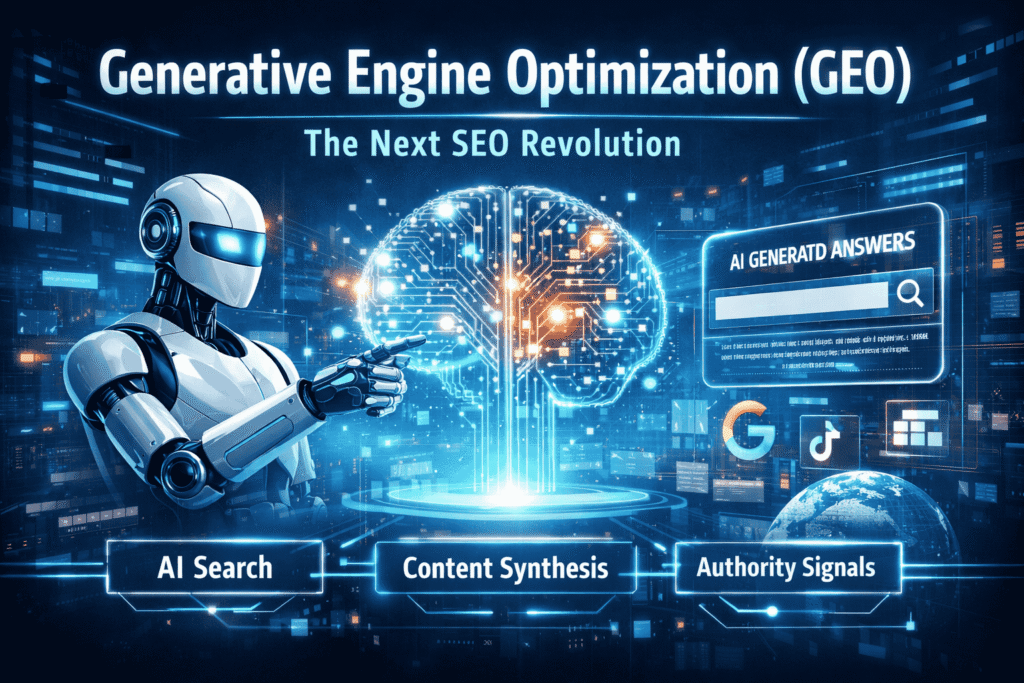
Introduction: Search Has Quietly Mutated
For more than two decades, search engines functioned like vast digital libraries. Users typed queries, algorithms scanned indexes, and results appeared as ranked blue links. The discipline of Search Engine Optimization grew around this architecture, refining strategies to improve rankings, visibility, and click-through rates. But the search landscape is no longer just a library. It has become a conversational intelligence layer.
Today, users increasingly receive direct answers generated by artificial intelligence rather than lists of websites. Systems powered by large language models synthesize information, summarize sources, and deliver conclusions instantly. This transformation has introduced a new paradigm known as Generative Engine Optimization (GEO), a strategic evolution beyond traditional SEO.
GEO focuses on optimizing content not merely to rank in search results, but to be selected, synthesized, and cited by AI-driven answer engines such as OpenAI, Google, Microsoft, and emerging platforms like Perplexity AI.
This shift is not a minor algorithm update. It represents a structural redefinition of how information is discovered, evaluated, and delivered online.
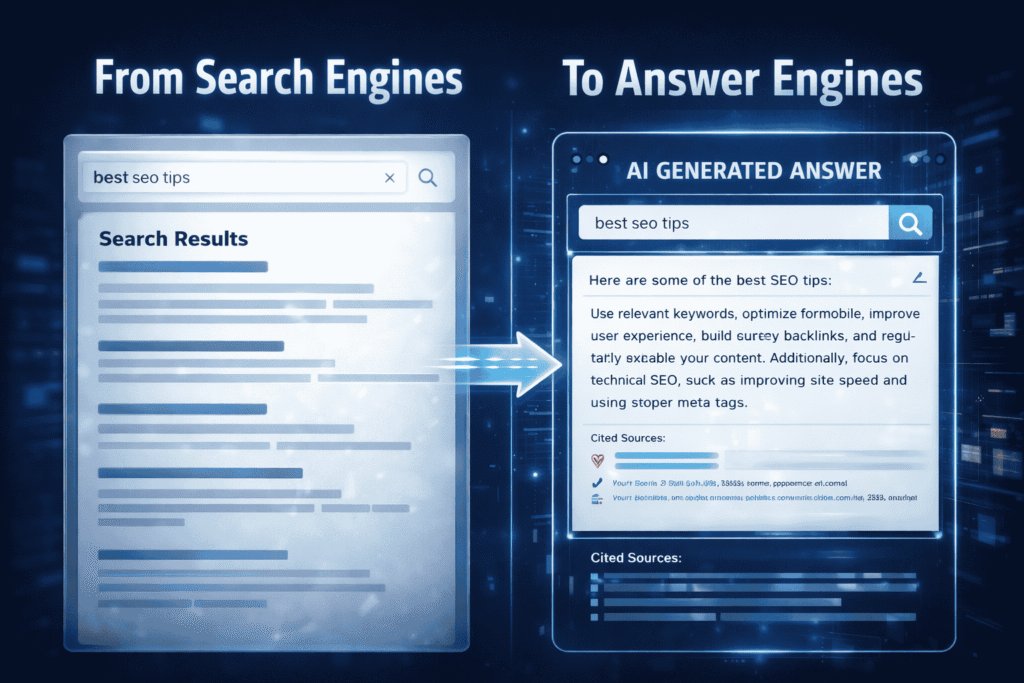
Chapter 1: From Search Engines to Answer Engines
Traditional search engines relied primarily on ranking signals such as backlinks, keyword relevance, domain authority, and technical performance. Users then chose which result to click.
Generative systems invert that model. Instead of presenting options, they generate a synthesized response. The user may never click any website at all.
This shift produces three fundamental changes:
- Visibility replaces ranking as the core objective.
Being first in search results is less valuable if the AI summarizes a different source. - Citation replaces traffic as the primary currency.
A brand mentioned in an AI answer can gain authority even without a click. - Semantic understanding replaces keyword matching.
AI systems interpret meaning, context, and intent rather than exact phrases.
In effect, the interface between user and web content is no longer a results page. It is a language model.
Chapter 2: Defining Generative Engine Optimization
Generative Engine Optimization (GEO) is the practice of structuring content so AI systems can easily interpret, trust, and use it when generating responses.
Where SEO asks:
“How do I rank for this keyword?”
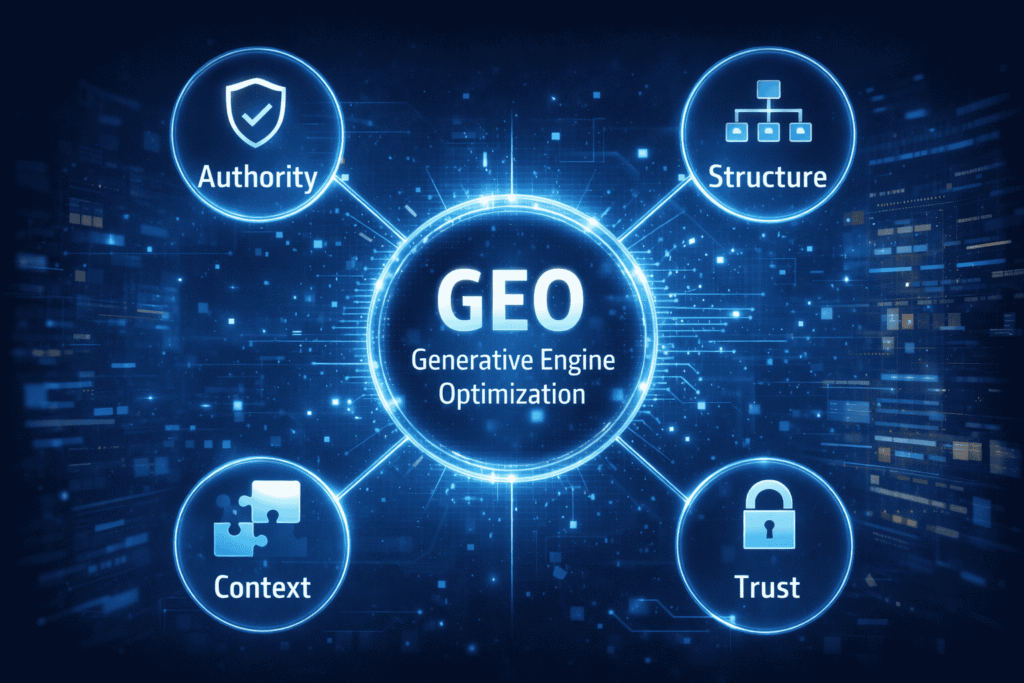
GEO asks:
“How do I become the trusted source AI selects when answering this question?”
This distinction changes everything.
GEO involves optimizing for:
- semantic clarity
- topical authority
- factual reliability
- contextual completeness
- structured information
In practical terms, GEO focuses on making content machine-understandable, not just human-readable.
Chapter 3: Why GEO Exists Now
Several technological shifts converged to create the conditions for GEO.
1. Large Language Models Became Search Interfaces
Models such as ChatGPT and Gemini transformed user expectations. People realized they could ask complex questions conversationally and receive synthesized answers instantly.
Once users experienced this interaction style, traditional keyword search began to feel inefficient.
2. Search Engines Integrated Generative AI
Major platforms began embedding AI summaries directly into search results. These summaries aggregate information from multiple sources and display a synthesized answer at the top of the page.
This means users often obtain their answer before scrolling.
3. Information Overload Forced Summarization
The internet now contains more content than any human could manually process. AI systems solve this overload problem by condensing thousands of pages into a single response.
Content that cannot be easily summarized risks invisibility.
4. User Behavior Changed
Users increasingly prefer:
- conversational queries
- natural language questions
- multi-step problem solving
This behavior aligns perfectly with generative engines, which excel at dialogue and reasoning rather than keyword matching.
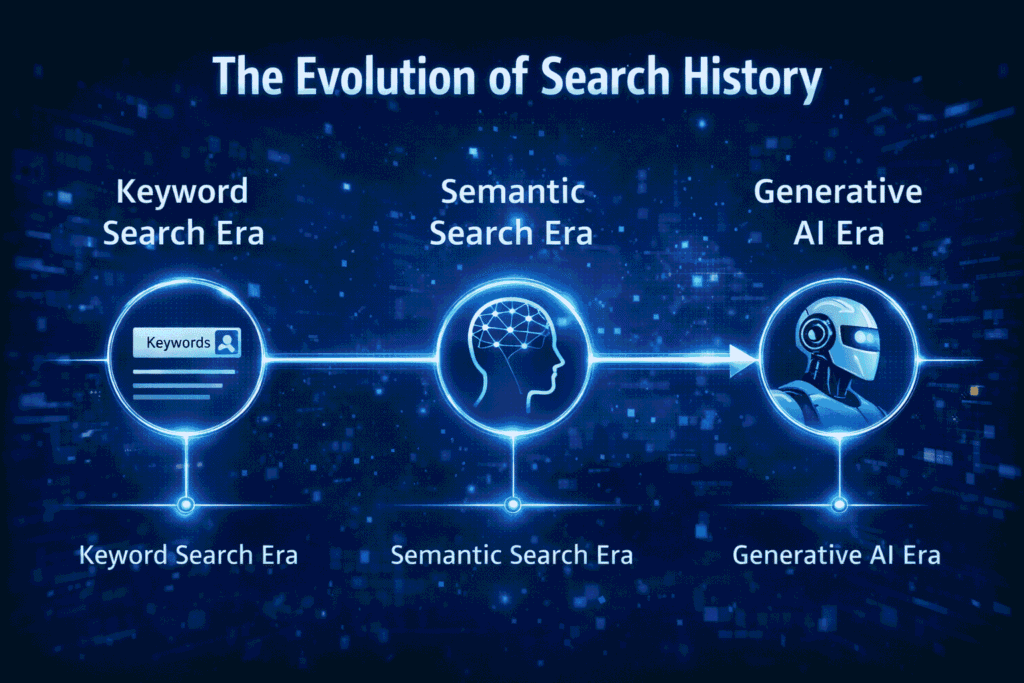
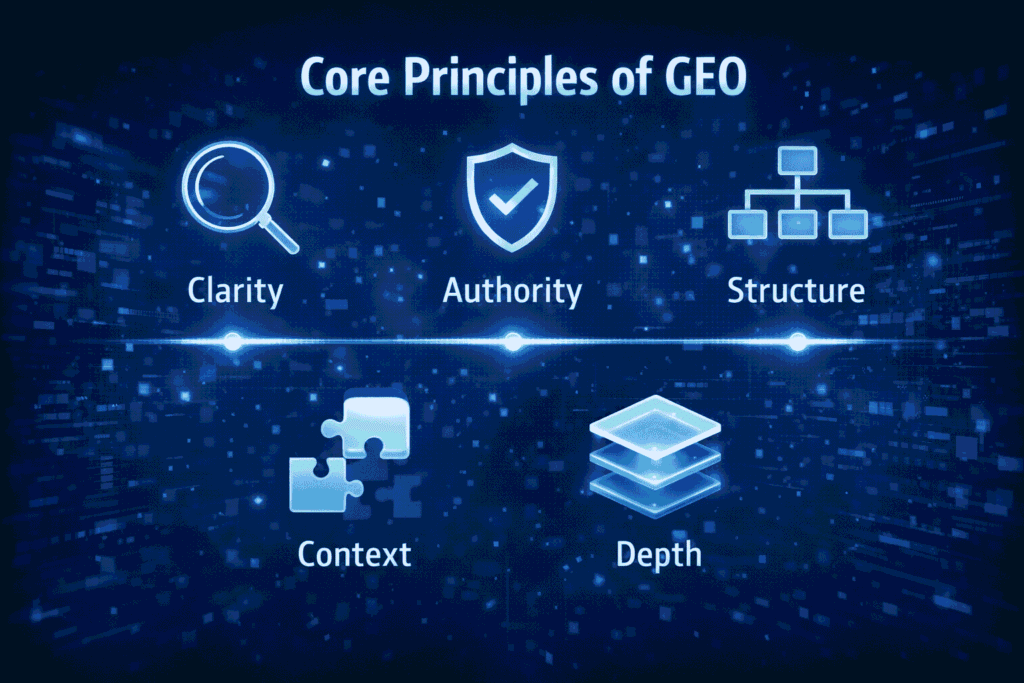
Chapter 4: The Core Principles of GEO
To optimize for generative engines, content must satisfy several technical and semantic conditions.
Principle 1: Clarity Over Cleverness
Language models interpret literal meaning. Ambiguous writing, excessive metaphors, or vague statements reduce extractability.
Effective GEO content:
- defines terms clearly
- answers questions directly
- avoids filler language
- structures ideas logically
Principle 2: Authority Signals Matter More Than Ever
Generative systems weigh trustworthiness heavily. They prioritize sources demonstrating:
- expertise
- accuracy
- consistency
- credibility
Signals that strengthen authority include:
- author credentials
- citations
- data references
- original research
- consistent topical focus
Principle 3: Structured Information Improves Extractability
AI systems parse content more efficiently when information is structured.
Useful formats include:
- bullet lists
- numbered steps
- tables
- FAQs
- definitions
Structured content reduces ambiguity and increases the probability of being quoted or summarized.
Principle 4: Context Completeness
AI engines prefer sources that answer a query comprehensively rather than partially. A page that addresses multiple related questions has higher selection probability than one covering only a narrow fragment.
Comprehensive content becomes a preferred training and retrieval source.
Principle 5: Semantic Depth
Traditional SEO sometimes rewarded repetition of keywords. GEO rewards depth of understanding.
Content must demonstrate:
- conceptual explanation
- relationships between ideas
- cause-and-effect logic
- real examples
The richer the semantic context, the easier it is for AI to integrate the information into generated answers.
Chapter 5: SEO vs GEO Comparison
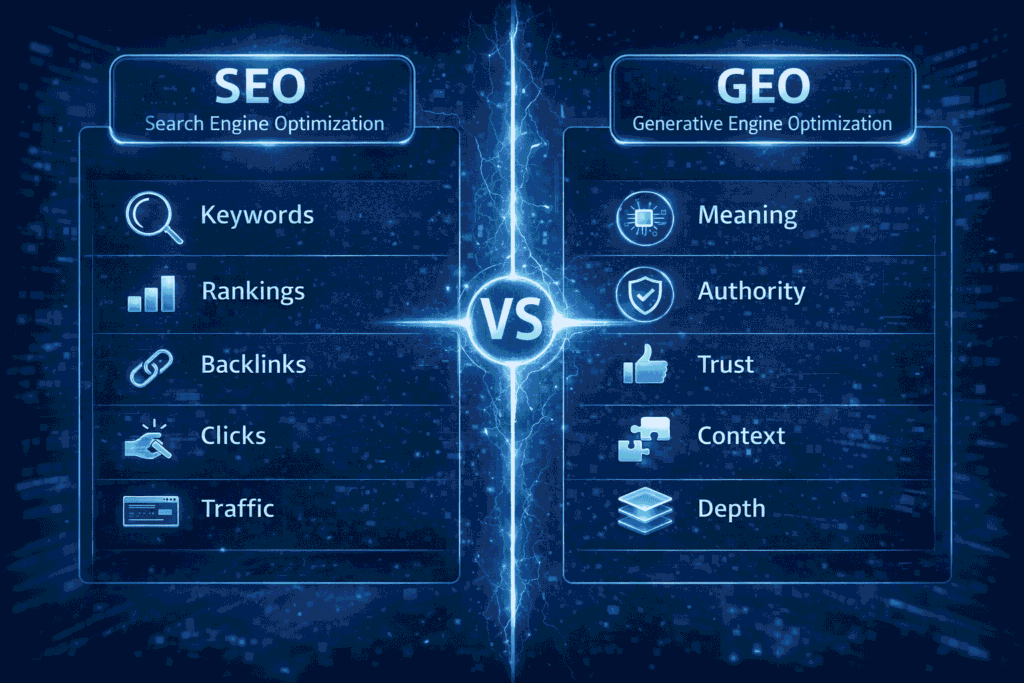
| Dimension | Traditional SEO | GEO |
|---|---|---|
| Primary Goal | Rank higher | Be cited in AI responses |
| Optimization Focus | Keywords | Meaning |
| Success Metric | Clicks | Mentions |
| Content Style | Keyword targeted | Conceptually comprehensive |
| Structure | Optional | Essential |
| Authority | Helpful | Critical |
This table highlights a simple truth: GEO does not replace SEO. It expands it. Websites must now optimize for both ranking systems and generative systems simultaneously.
Chapter 6: How Generative Engines Choose Sources
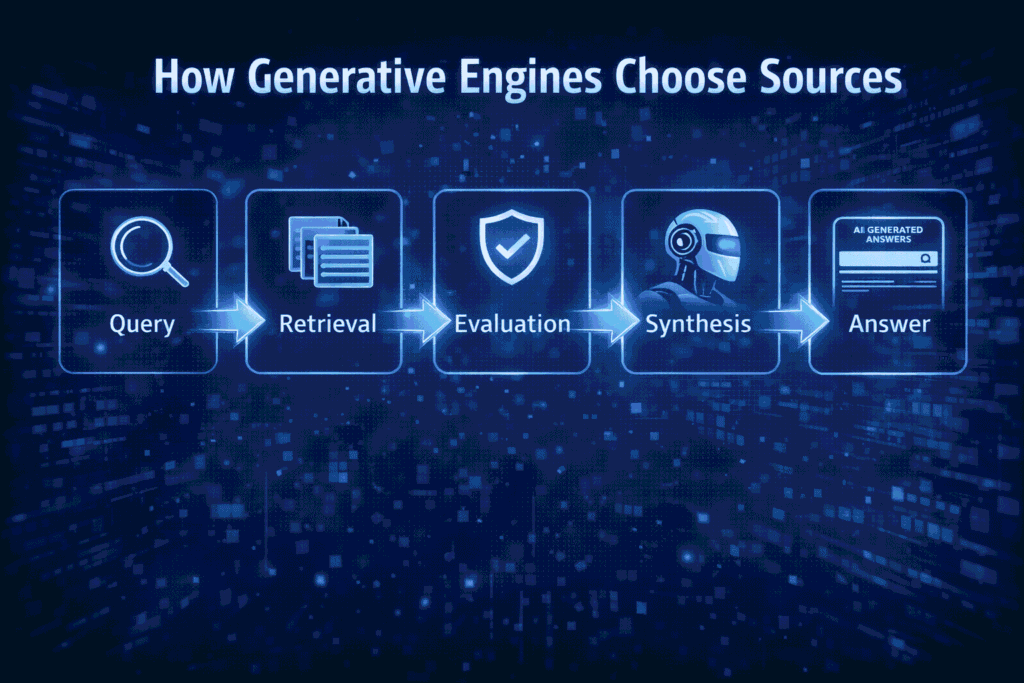
Understanding how AI selects sources is essential for GEO strategy.
Generative systems typically rely on three layers:
Layer 1: Retrieval
The model retrieves relevant documents from its indexed or connected data sources.
Selection factors include:
- semantic relevance
- topical authority
- freshness
- reliability
Layer 2: Evaluation
The model evaluates retrieved content based on:
- factual consistency
- completeness
- clarity
- redundancy with other sources
Sources that conflict with multiple reliable documents may be discarded.
Layer 3: Synthesis
The AI combines validated information into a single coherent response. During synthesis, it prefers:
- concise definitions
- structured explanations
- well-organized facts
Content written in this style has a higher probability of being included.
Chapter 7: GEO Content Architecture Framework
To optimize for generative engines, content should follow a specific architecture.
Section 1: Direct Answer
Start with a concise answer to the primary question. This increases extractability and helps AI quickly identify relevance.
Section 2: Expanded Explanation
Provide deeper detail explaining the concept thoroughly.
Section 3: Supporting Evidence
Include:
- data
- studies
- statistics
- examples
Section 4: Related Questions
Address adjacent queries users might ask. This broadens topical coverage.
Section 5: Structured Summary
End with bullet points or key takeaways.
This layered architecture mirrors how AI systems analyze information.
Chapter 8: Technical GEO Optimization
Technical structure influences whether AI systems can parse your content effectively.
Important elements include:
- clean HTML structure
- descriptive headings
- schema markup
- accessible formatting
- fast loading speed
Technical friction reduces crawlability and may prevent AI from extracting content accurately.
Chapter 9: Authority Engineering for GEO
Authority is no longer just about backlinks. It is about perceived reliability across multiple signals.
Key authority-building strategies:
- Publish original research
- Provide expert analysis
- Maintain consistent topical focus
- Update content regularly
- Earn citations from trusted domains
Generative systems often cross-reference sources. If multiple authoritative websites confirm your information, your probability of being cited increases dramatically.
Generative Engine Optimization GuideChapter 10: The Rise of Citation SEO
A new discipline is emerging inside GEO known as Citation Optimization.
Its objective is simple:
Ensure your brand is mentioned when AI answers questions in your niche.
Citation optimization involves:
- publishing quotable statements
- creating definitive definitions
- producing statistics others reference
- building unique frameworks
If your content becomes the origin of widely cited information, AI systems are more likely to reference it repeatedly.
Chapter 11: GEO Keyword Strategy
Keywords still matter. But their role has evolved.
Instead of optimizing for individual phrases, GEO targets question clusters.
Example:
Traditional SEO keyword:
“email marketing tips”
GEO cluster:
- how to improve email open rates
- what increases email conversions
- best email subject line strategies
- why email campaigns fail
By answering an entire cluster, your content becomes a comprehensive resource AI systems prefer.
Chapter 12: Conversational Query Optimization
Users increasingly interact with search systems conversationally. Queries now resemble spoken dialogue rather than typed keywords.
Example evolution:
Old search query:
best CRM software
New conversational query:
What is the best CRM for a small consulting business that wants automation and low cost?
GEO content should therefore include:
- natural language questions
- detailed answers
- contextual explanations
This ensures relevance to real user conversations.
Chapter 13: GEO Content Types That Perform Best
Some formats are naturally optimized for generative engines.
High-performing formats include:
- ultimate guides
- comparison articles
- definition posts
- how-to tutorials
- research reports
- expert roundups
These formats contain dense informational value, making them ideal for AI synthesis.
Chapter 14: The Role of E-E-A-T in GEO
Experience, Expertise, Authoritativeness, and Trustworthiness remain foundational.
Generative systems evaluate credibility signals such as:
- author bios
- professional credentials
- real-world experience
- transparent sourcing
Anonymous or thin content is less likely to be selected.
Chapter 15: Brand Visibility Without Clicks
One of the biggest shifts GEO introduces is the concept of zero-click authority.
Users may learn about your brand through AI answers even if they never visit your site. This creates a new brand awareness channel.
Benefits include:
- authority positioning
- trust building
- brand recall
- perceived expertise
Traffic still matters, but visibility now extends beyond page visits.
Chapter 16: Measuring GEO Success
Traditional SEO metrics include:
- rankings
- impressions
- clicks
GEO requires additional metrics:
- AI citation frequency
- brand mentions in generated answers
- inclusion in AI summaries
- semantic visibility
New analytics tools are emerging to track these signals.
Chapter 17: GEO for Different Industries
E-commerce
Focus on structured product data, comparisons, and FAQs.
SaaS
Provide technical documentation and deep guides.
Healthcare
Prioritize accuracy, citations, and expert review.
Education
Offer comprehensive explanations and conceptual clarity.
Each industry requires tailored GEO strategy aligned with user intent patterns.
How to Get Clients for Your Travel Business in 2026Chapter 18: Risks and Challenges
Despite its advantages, GEO introduces new complexities.
Challenges include:
- lack of transparency in AI selection logic
- difficulty tracking citations
- rapid algorithm evolution
- risk of misinformation synthesis
Brands must remain adaptable as generative technology evolves.
Chapter 19: GEO Implementation Roadmap
Organizations can adopt GEO through a structured process.
Step 1: Audit existing content
Identify pages with strong topical authority.
Step 2: Improve structure
Add headings, lists, and summaries.
Step 3: Expand depth
Answer related questions.
Step 4: Add credibility signals
Include author info and sources.
Step 5: Monitor AI mentions
Track visibility across generative platforms.
Chapter 20: The Future of Search Belongs to Synthesized Knowledge
Search is shifting from navigation to knowledge delivery.
In the past:
Users searched to find websites.
Now:
Users search to receive answers.
This transformation means content must evolve from being merely discoverable to being understandable, reliable, and quotable.
Generative engines reward content that functions like a trusted reference source rather than a marketing page.

Conclusion: GEO Is Not Optional
Generative Engine Optimization is not a trend. It is an inevitable stage in the evolution of information retrieval.
As AI systems become primary gateways to knowledge, brands that optimize for generative visibility will dominate digital authority. Those that rely solely on traditional ranking tactics risk fading into algorithmic obscurity.
The future of search will not be defined by who ranks first.
It will be defined by who gets quoted.
GEO is the strategy that determines that outcome.